

There are many things I love about videogames and their making, I’m really aware is just an unconditional love as no matter what is happening at this inhuman industry I connect with them again and again.
Let me be honest, my motivation at the their making goes up and down when I think twice the amount of work is behind them. It is just when I watch trailers with interesting aesthetics that my motivation energy bar is charged again.
Exactly, making efforts, putting all your passion and investing time, you would be able to make something close to the scope of Work Work Work… Adding your style and personality, right?
I really think it could be possible and my fuel is not only about comparing myself with good-appealing videogames that are somehow close the standard I have.
But my main fuel as many of you know comes from Aesthetics.
Bonus: Airframe Ultra - Another example of interesting aesthetic and strong personality for a videogame
Take the previous trailers as a warm-up for what is coming on this article.
Japan and It’s Peak of Style
The videogame industry has been evolving during the last 50 years in terms of different styles, drawing and modelling methodology, from 2D to hyper realistic 3D models, but my taste for aesthetics is always frozen at the titles published by SEGA.
I clearly remember, I was on a mall center with my parents, they were quite busy taking groceries and suddenly my perception of time and space was completely frozen because I had Jet Set Radio in front of me.
A beautiful SEGA Dreamcast system (I still have one!) with Jet Set Radio running on it.
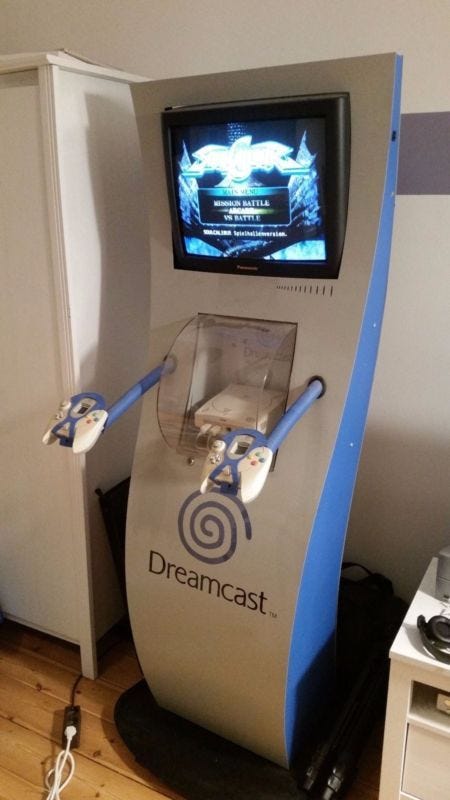
That was the first time I’ve seen cell-shading technique applied to 3D Models, and actually it was the first game released with that style.
Back then I didn’t have the concepts I understand now related with gamedev art workflows, so I was even more impressed, my mind was like: is this possible on a videogame?! Of course it was…
Jet Set Radio became my main source of inspiration and motivation when I actually think about videogames and gamedev.
Shibuya Punk Style (Or Grind Fiction)
Since then, I’ve been loving those shaders and outlines at cel-shading models, but Jet Set Radio isn’t just that, it is a whole culture pop bomb (umami for a taste) with just the required portions of ingredients to be a perfect recipe for an extremely engaging urban representation.
The idea for the game originated from lead artist Ryuta Ueda’s desire to move away from the overtly fantastical designs common in Japanese media at the time.
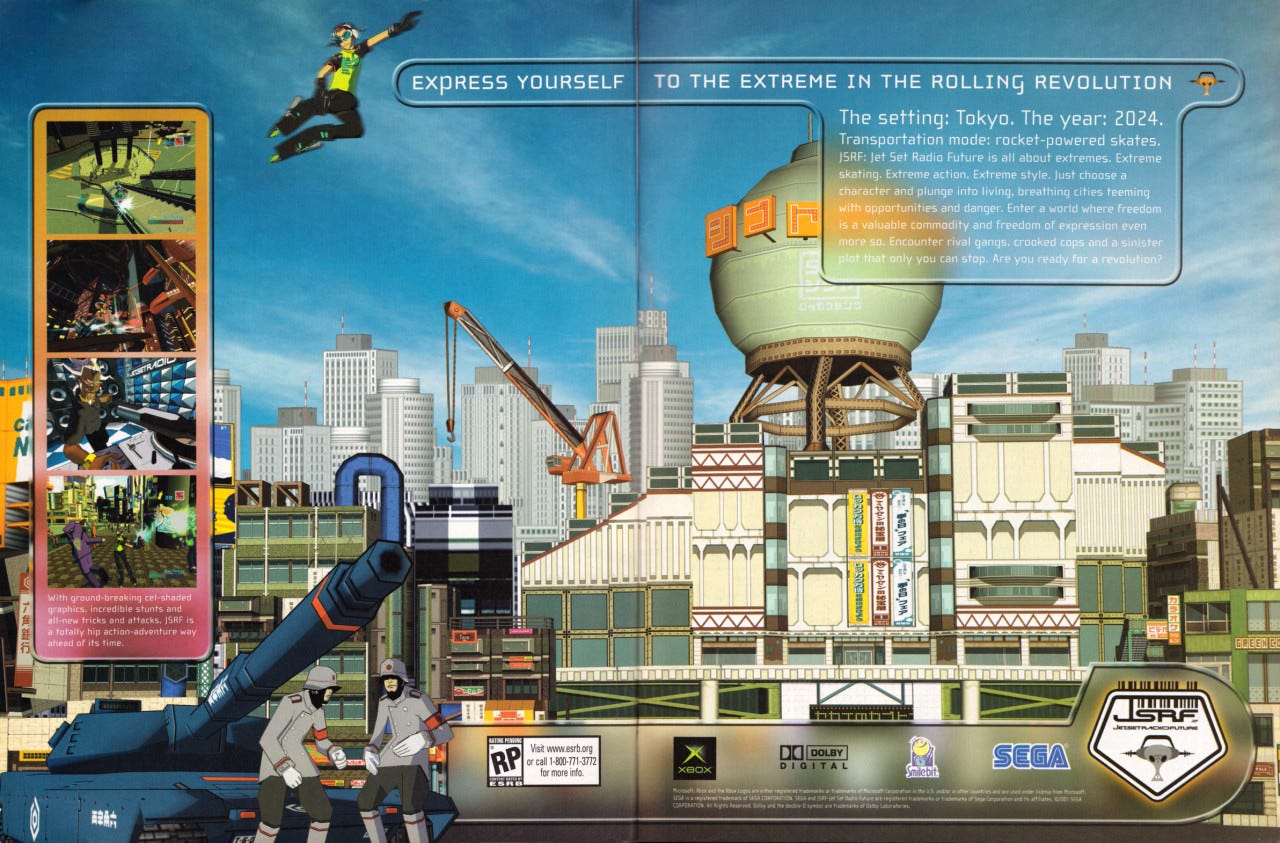
The team behind Jet Set Radio wanted to capture not only looking at streetwear style based on trends at during the videogame development, but also a high level of sensorial connection by creating a mix between hip-hop, Jazz and R’nB music.
This impressive combination is like the russian dolls, they doesn’t only combine music, aesthetic and environments, but on top of it’s key elements design there is also a combination of Punk Urban culture, Anime and Japanese environments as their theme.
Creating an emotion of Rebellion, individuallity and coolness that is rarely found at any other videogame you can think about. (Saying this with the permission of Persona 5)
If you really like this style and genre as I like, you should keep an eye to Hyperfunk from the Reptile Team, creators of Bomb Rush Cyberfunk
What Can We Learn From This?
Personality at videogames is linked with their exponent of expression, meaning how many cohesive elements are involved at their creative process, those elements could be coming from different artistic media (Music, Models, Sprites, Environments) and if you do it right, the total personality value will be higher than the sum of all the individual elements.
Thank you for reading